



I spent three years climbing the ranked ladder in another blockchain card game before I quit. Loved most of it. The brawls, the collecting, that little hit when a bronze-tier team you drafted on a whim beats someone two leagues above you. So building a crypto card game of my own was never an act of revenge against what came before. It was about the one thing that kept breaking, over and over, in every game like it.
Stellarch's airlock is open now: the Stellarch open alpha is live, anyone can sign up and play, and I want to tell you why the game exists before some third party tells you for me.
What made me walk away from a crypto card game I actually loved?
Short version: the card game stayed good, but the money story bolted onto it got greedy, and the updates I was waiting on slowed to a crawl.
Let me be fair to the incumbent, because that honesty is the whole point of this blog. Splinterlands earned its spot. It was briefly the single most-active blockchain game by daily users, it still ships real updates, and the community is genuinely sharp. None of that is the problem.
The problem is a pattern, and it's bigger than any one game. The token economy gets designed before the fun does. Axie Infinity is probably the textbook case: its in-game token fell 94% before Sky Mavis had to slash its own emissions to stop the bleeding, and then a $625 million hack of its Ronin network turned a slow leak into a flood. Gamification researcher Yu-Kai Chou called that economy "a pyramid," where new player deposits paid old player withdrawals. Reason's Daniel Friedman put the math even plainer: the real-money economy was "zero sum," with no money produced inside the game at all.
That's what I left. Not the card game. The spreadsheet stapled to it.
Is another crypto card game even worth building when the category looks dead?
Fair question, and here's my honest answer: the category cooled off hard, but it didn't die.
The receipts are real, at least as real as anything gets in crypto data. DappRadar's mid-2025 data, via CoinDesk, shows daily active wallets across all of blockchain gaming falling to a two-and-a-half-year low, funding down 93% year over year, and more than 300 games going dark in a single quarter. Move-to-earn broke the same way, only faster. StepN's main token fell 98% in two months once the fresh deposits it needed to pay walkers dried up.
So yeah. Launching a new crypto card game straight into that is either stupid or deliberate. I'd argue deliberate. When the tourists leave, the people building for the actual game are the ones left standing. Even Sky Mavis, the company at the center of the worst of it, told DL News "we keep building." I get it. So do we.
So what did we build differently?
One sentence: a crypto card game where you can check the result instead of taking our word for it.
Is it legit? Can I trust the outcome?
Yes, and you don't have to trust me on that, which is the entire point.
Combat in Stellarch is deterministic. You draft a 7-card team, six Fighters and one commander, and the match resolves through a seeded engine. Same teams, same mana cap, same ruleset, same seed: the result is byte-identical, every single time. Every match replays from its seed, so you can re-run the whole thing and confirm the winner yourself. Most "provably fair" claims in crypto gaming are only about one random roll being unrigged. This is the stronger version. The entire match is reproducible, not just a die.
Here is one you can test yourself.
Do I need a wallet, and is it safe to try?
No wallet, and nothing to lose. Sign up with Google, a Ronin or Ethereum address, Hive Keychain, or none of the above (sign-in methods and key custody).
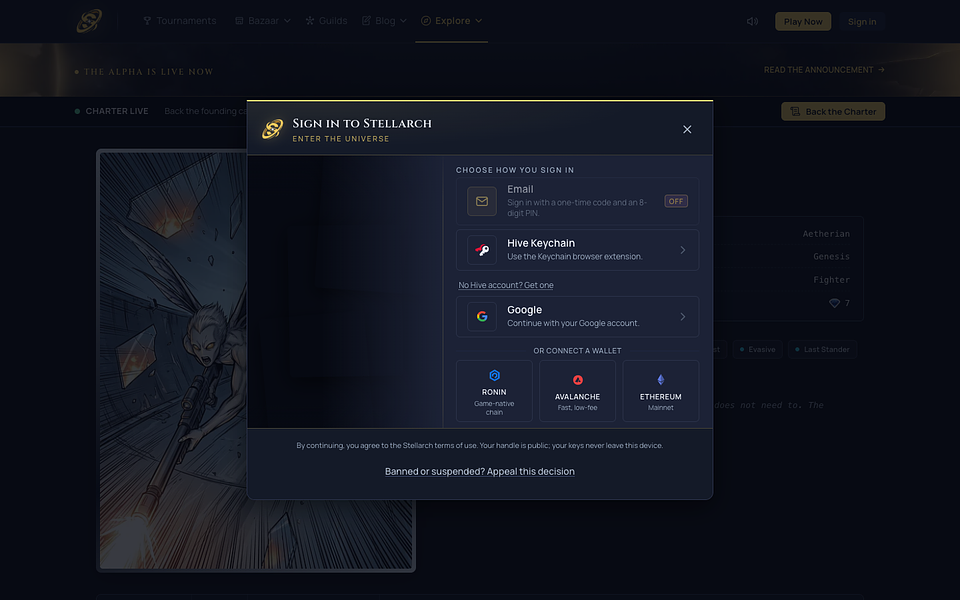
New accounts draft a full legal team from a free ghost-catalog floor. No card purchase, no deposit needed. Ownership only ever adds options on top of that floor, it never locks you out. And because the engine is deterministic, no card is a guaranteed win, and no wallet size buys you one. Your draft decides the match, not your bankroll. (I'll admit the dark space-opera card art is also just really good, but that's a different pitch for a different day.)
How much can you actually earn?
Straight answer, no moon talk: you earn SGC for ranked wins, drawn from fixed per-league reward pools, not from open-ended emissions.
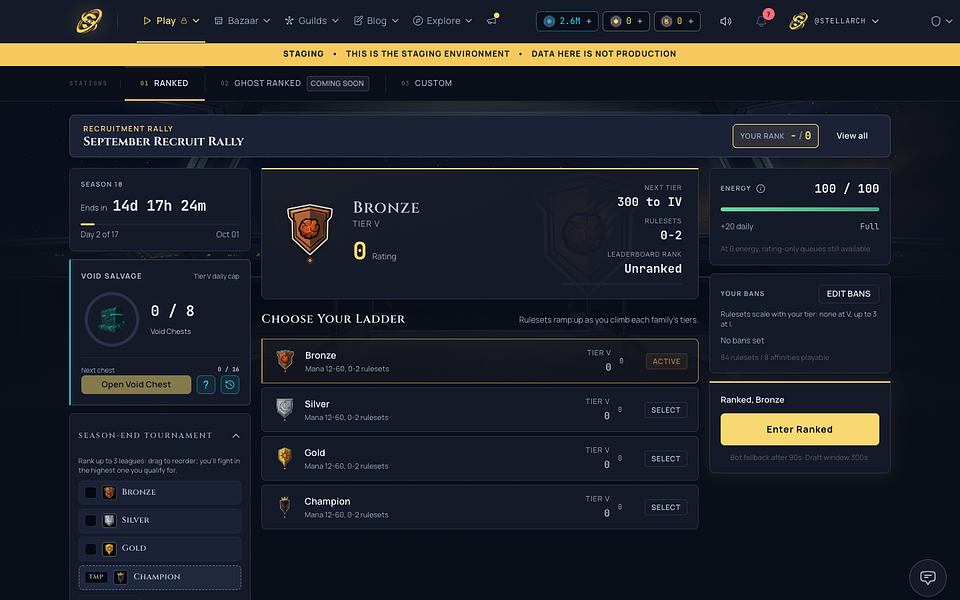
That one distinction is the whole lesson of the last cycle. A fixed pool can't spiral the way Axie's and StepN's did, because it isn't funded by the next person who signs up. It's a bounded reward for playing well, not a salary and not an investment. SGC is product-backed at a store floor of $0.001, so it's tied to something you can actually spend it on. STEL rewards and a path from STEL to SGC are the next phase, and honestly, not something I'm going to pretend is finished today.
Because this is the register I want the blog to keep: it's alpha. Leagues, season tournaments, brawls, in-game and guild chat, the tutorial, the Battle Lab, your collection and cosmetics are all live and playable right now, in the browser, no download. Parts of the economy are still gated and on the roadmap, and I'll tell you which parts as they ship, in changelogs you can check against the actual build.
The airlock's open. Come break something and tell me what broke.
So what can you actually play today?
When I say alpha, I do not mean a login screen and a promise. The leagues and the ranked ladder are running, and the season tournaments sit right on top of them. Finish high enough in your league and you drop into a bracket at the end of the season, playing for the real prize, with a better seed for the people who climbed hardest.
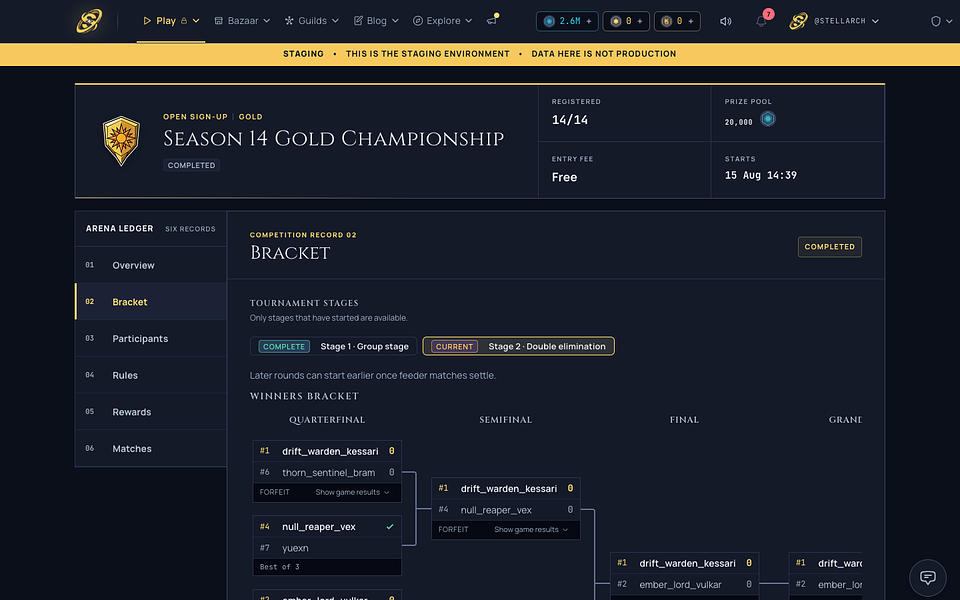
Brawls were my favourite part of the old game, so they were never optional here. The difference this time is the guild side. In most games, running a guild is a second job you do in a spreadsheet: who is filling which slot, who has submitted, where a series stands. We put all of that in the game, next to the direct messages and guild chat, so you are not dragging every conversation off to a separate app.
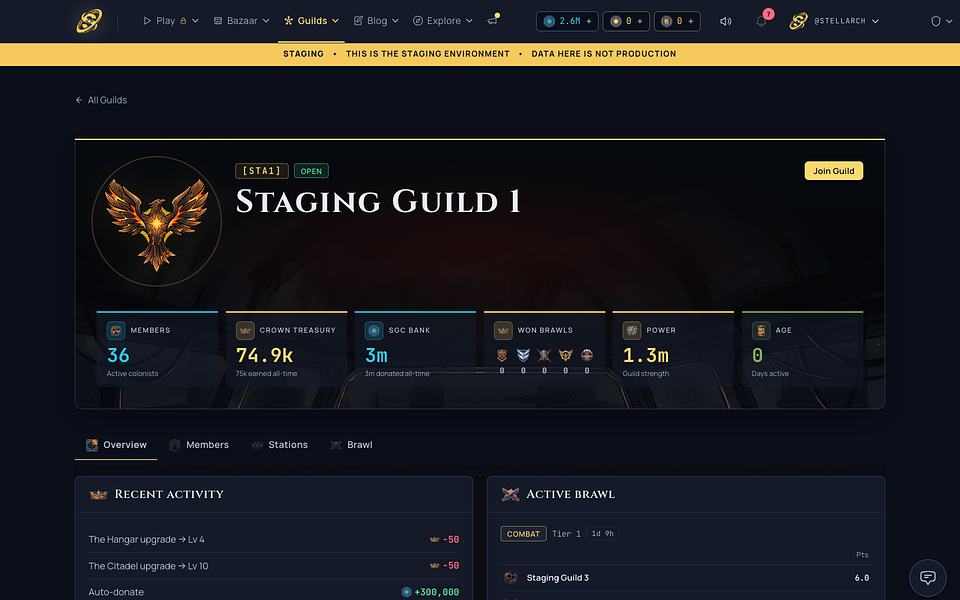
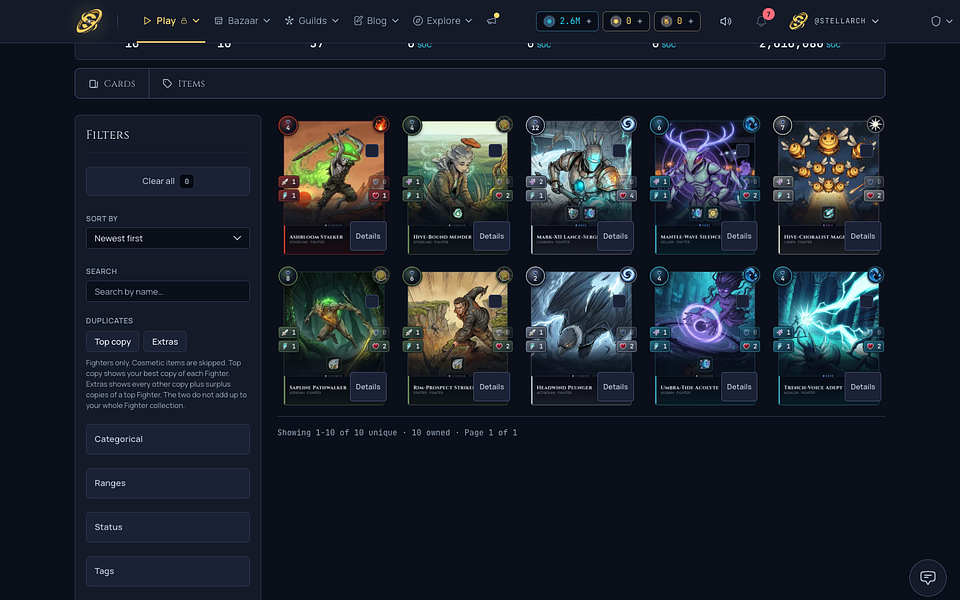
Your cards are real assets, so your collection and the market both live on the site you already use, not on a third-party tool that can break on a whim. Filters, listings and trades sit in one place, and avatars, banners and titles let your account look like yours instead of like every other one.
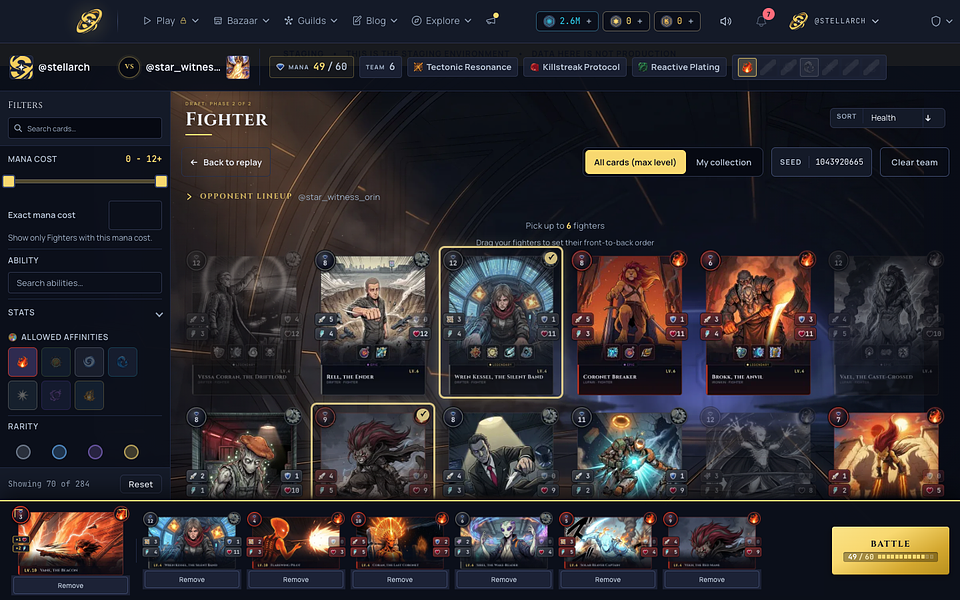
The piece I reach for more than I expected is the Battle Lab. Take a match you lost, rebuild the lineup, run it again, and watch what would have happened. It is theory-crafting with the real engine behind it, not a forum argument. There is a proper tutorial too, so a new player gets from zero to a real match without a wiki open on the second monitor.
Frequently asked
Is Stellarch's crypto card game live to play right now?
Yes. Open alpha is live and self-signup is open, so anyone can register and start drafting teams today. It's still alpha, so expect rough edges and some features that are still gated, but the core game is fully playable in your browser with no download.
Do I need a crypto wallet to start?
No. You can sign up with Google, a Ronin or Ethereum address, Hive Keychain, or nothing at all. New accounts get a full legal team from a free ghost-catalog floor, so you can play ranked without buying a single card or making any deposit.
Can you really earn from ranked matches?
You earn SGC for ranked wins from fixed per-league reward pools, not open-ended emissions. It's a bounded reward for playing, not a salary or a return promise. STEL rewards and a path from STEL to SGC are planned for a later phase, and I won't call them live until they are.
What does "deterministic" actually mean for a card game?
It means the same teams, mana cap, ruleset, and seed always produce the same winner, byte for byte. Every match replays from its seed, so anyone can re-run it and confirm the outcome. You verify the fairness instead of trusting a claim about it.
Is the web3 card game category dead?
It cooled off, it didn't die. DappRadar's 2025 data shows a real, deep correction across blockchain gaming, with hundreds of games going quiet. Stellarch is a bet that a fixed-economy, no-pay-to-win crypto card game can sit on the right side of that shakeout.